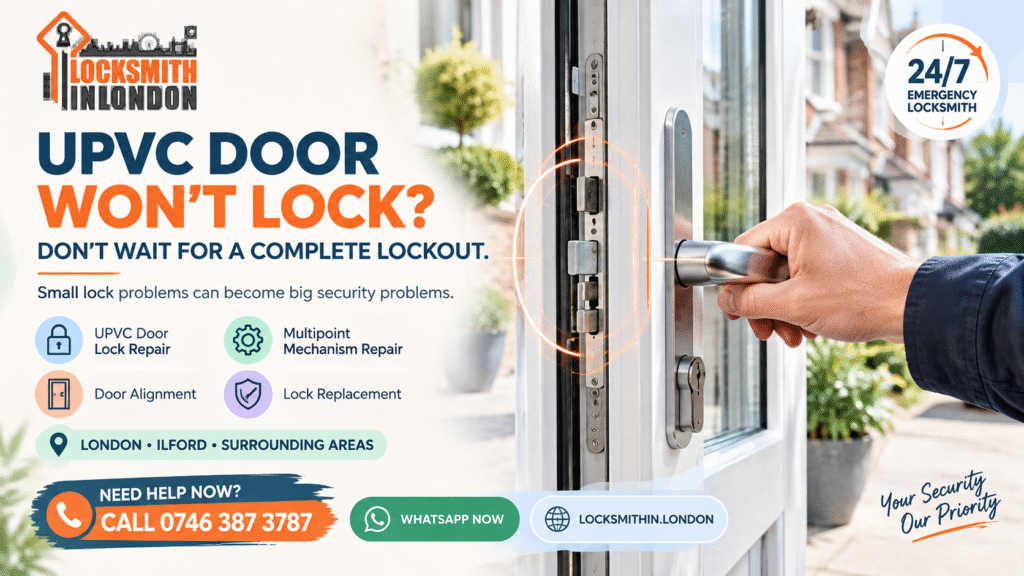
UPVC Door Won’t Lock London? 10 Causes You Shouldn’t Ignore
UPVC door won’t lock London problems can start with something that seems minor: a handle that feels stiff, a key that suddenly becomes difficult to turn, or a door that closes but refuses to lock. However, these symptoms can indicate a problem with the cylinder, gearbox, hinges, alignment or multipoint locking mechanism.
If your UPVC door is becoming difficult to secure, don’t keep forcing the handle or key. A small mechanical problem can become a complete lockout or leave the property less secure.
For professional help, Locksmith In London provides residential and business locksmith services across London, including lock repairs, replacements and emergency assistance. The company’s website states that its services have been operating in London since 2015 and are available 24/7.
Need help now?
Table of Contents
Why Won’t a UPVC Door Lock?
A modern UPVC door usually relies on several components working together.
The handle operates the locking mechanism, while the gearbox transfers movement to the hooks, rollers or bolts around the door. The cylinder allows the key to operate the locking system.
If one part starts failing, the whole system may stop working correctly.
London’s Metropolitan Police explains that modern multi-locking and UPVC doors commonly use hooks and latches and recommends the “lift, lock and remove” process when securing these doors.
This means a door that suddenly refuses to lock should not simply be ignored.
10 Causes You Shouldn’t Ignore
1. Misaligned UPVC Door
One of the most common reasons a UPVC door refuses to lock is alignment.
Over time, a door can drop slightly because of regular use, hinge movement, building movement or changes in temperature.
When the door is closed, the locking points may no longer line up correctly with the keeps in the frame.
You may notice that:
- The handle feels unusually stiff.
- The door needs to be pushed or pulled.
- The key turns only partially.
- The door locks when open but not when closed.
This last symptom is particularly useful.
If the mechanism works normally with the door open but fails when the door is closed, alignment is worth investigating.
2. A Worn Multipoint Locking Mechanism
UPVC doors often use multipoint locking systems.
These can contain several locking points positioned around the door. With years of use, internal components can wear.
A worn mechanism may initially feel slightly stiff before eventually failing.
That is why waiting until the mechanism completely breaks can turn a straightforward repair into an emergency call-out.
3. Faulty UPVC Gearbox
The gearbox is an important part of the locking mechanism.
It transfers the movement from the handle or cylinder to the locking points.
When the gearbox begins failing, the handle may move without properly operating the locks.
You might hear clicking, grinding or unusual mechanical noises.
In some cases, replacing the appropriate gearbox can restore the door without replacing the entire door.
4. Damaged or Worn Euro Cylinder
The cylinder is the part where you insert your key.
A worn cylinder may become difficult to turn or may stop operating the locking mechanism properly.
A cylinder can also become damaged after years of use.
If the key suddenly becomes stiff, don’t repeatedly force it.
A snapped key inside the cylinder can make the situation considerably more difficult.
For security-conscious homeowners, the Metropolitan Police recommends considering 3-star euro cylinder locks meeting TS007 when upgrading certain door locks.
5. Handle Problems
Sometimes the lock itself isn’t the original problem.
A loose, stiff or damaged handle can prevent the locking mechanism from operating correctly.
If the handle drops but doesn’t return properly, feels loose or requires excessive force, stop repeatedly forcing it.
The handle may be connected to a mechanism that is already under stress.
6. Dirty or Obstructed Keeps
The keeps are the parts mounted to the door frame that receive the locking points.
Dirt, debris, damaged metalwork or a displaced keep can interfere with locking.
However, avoid aggressively modifying the frame yourself.
If the locking points are not entering the keeps correctly, the underlying issue may be alignment rather than dirt.
7. Door Has Dropped
UPVC doors are heavy and experience constant movement.
If hinges become worn or the door shifts slightly, the locking points can stop lining up with the frame.
A simple adjustment may sometimes resolve the issue.
But forcing the handle harder isn’t a reliable solution.
8. Broken Internal Components
A mechanism can sometimes fail internally without obvious external damage.
The handle may appear normal, yet the locking points don’t move correctly.
This is one of the situations where professional diagnosis is useful because replacing the wrong component can waste time and money.
9. Previous Repairs Were Incorrect
A UPVC door may develop problems after unsuitable parts have been fitted or adjustments have been made incorrectly.
If the door has recently been repaired, check whether the problem started shortly afterwards.
A professional locksmith should assess the complete mechanism rather than automatically replacing the most visible component.
10. The Lock Is Simply Worn Out
Sometimes the simplest answer is the correct one.
Locks and mechanisms have working lives.
If the door is old, heavily used or has experienced repeated faults, replacement may be more cost-effective than repeated repairs.
The correct solution depends on the condition of the door, mechanism, cylinder and frame.
Is It Safe to Leave a UPVC Door Unlocked?
No.
If your main entrance cannot lock properly, treat it as a security issue.
The Metropolitan Police states that doors and windows are important entry points and recommends securing them properly. It also advises homeowners to double-lock doors where appropriate.
Redbridge Council similarly advises residents to double-lock UPVC doors by lifting the handle and turning the key.
If your door will not lock at all, avoid assuming that simply closing it is enough.
The risk becomes even more important if:
- You are leaving the property unattended.
- The affected door is your main entrance.
- The door leads directly outside.
- You operate a shop or office.
- The locking mechanism is visibly damaged.
- You have already experienced a break-in.
For broader home security guidance, see:
Metropolitan Police home security advice
NPSA home security guidance
Redbridge Council burglary prevention advice
What Can You Check Yourself?
Before calling a locksmith, you can perform a few basic observations.
Check 1: Does the Door Lock When Open?
Open the door and carefully test the handle and key.
If the locking mechanism operates normally while the door is open but fails when the door is closed, alignment could be involved.
Check 2: Does the Handle Feel Different?
Pay attention to changes.
Is it:
- Stiffer than usual?
- Loose?
- Dropping?
- Not returning?
- Making unusual sounds?
These clues can help a locksmith identify the likely fault.
Check 3: Does the Key Turn?
Never force a key that feels stuck.
A damaged or snapped key can create an additional problem.
Check 4: Look at the Locking Points
When the door is open, observe whether the hooks, rollers or bolts move correctly when operating the handle.
Do not dismantle the mechanism unless you know exactly what you are doing.
What You Shouldn’t Do
When a UPVC door refuses to lock, avoid repeatedly forcing the handle.
Also avoid:
- Hammering the mechanism.
- Forcing the key.
- Randomly drilling the lock.
- Adjusting multiple components without diagnosis.
- Buying a replacement mechanism without checking compatibility.
- Leaving the door unsecured overnight.
A wrong adjustment can potentially make the mechanism harder to repair.
When Should You Call a Locksmith?
Call a professional if the problem is persistent, worsening or leaving the property unsecured.
You should especially consider urgent assistance when the door:
Will not lock at all.
Will not open.
Has a broken key.
Has a damaged cylinder.
Has a failed multipoint mechanism.
Is difficult to secure after a break-in.
For London homeowners searching for a locksmith near me, proximity and response time matter during an emergency.
Locksmith In London states that it provides 24/7 emergency services and aims to respond quickly across London.
UPVC Door Lock Repair vs Replacement
Not every faulty UPVC door needs a complete replacement.
A professional inspection should establish whether the problem involves:
| Problem | Possible solution |
|---|---|
| Door alignment | Adjustment |
| Loose handle | Handle repair/replacement |
| Worn cylinder | Cylinder replacement |
| Failed gearbox | Gearbox replacement |
| Damaged multipoint mechanism | Mechanism repair/replacement |
| Damaged keeps | Adjustment or replacement |
| Severely worn system | Full mechanism replacement |
The advantage of professional diagnosis is that you can avoid replacing components unnecessarily.
Locksmith In London says its approach includes repairing locks rather than automatically replacing them where repair is practical.
UPVC Door Won’t Lock London: Professional Repair Options
If your entrance is becoming difficult to secure, a locksmith can inspect the complete locking system.
Depending on the fault, the service may include:
UPVC door lock diagnosis
Multipoint mechanism repair
Gearbox replacement
Euro cylinder replacement
Door alignment
Handle repair
Lock adjustment
Emergency lock repair
Complete lock replacement
For general information about lock standards, BSI currently lists BS 3621:2017+A1:2024 as the current version of that particular standard for key-operated single-point lock assemblies.
For security product information, you can also review:
Secured by Design
BSI Knowledge
Master Locksmiths Association
Yale Home UK
ASSA ABLOY
Emergency UPVC Locksmith London
A faulty UPVC lock becomes more urgent when you cannot secure the property.
For example, imagine leaving work at 7pm and discovering that your front door suddenly refuses to lock.
You could spend the evening repeatedly trying the handle, searching online for parts or attempting a DIY repair.
Or you could have the mechanism professionally assessed.
If your UPVC door is already failing, don’t wait for the moment it completely stops working.
Locksmith In London advertises 24/7 emergency locksmith services for residential, commercial and automotive situations and provides lock repairs and replacements.
Need urgent help?
Residential & Commercial UPVC Door Problems
This issue isn’t limited to houses.
UPVC doors are also found in flats, rental properties, offices, commercial units and other buildings.
For landlords and property managers, a door that cannot lock can create an immediate security and access problem.
For businesses, it can also affect opening, closing and staff access.
Locksmith In London states that it provides both residential and business locksmith services across London.
If you’re a landlord, property manager or business owner, don’t wait until a tenant or employee reports a complete lock failure.
Early inspection can potentially prevent a more disruptive emergency.
UPVC Door Lock Repair London Pricing Guide
The final cost depends on the exact component, door type, mechanism and time of service.
A professional should diagnose the problem before confirming the appropriate repair.
| Service | Typical consideration |
|---|---|
| UPVC lock adjustment | Depends on alignment and mechanism |
| UPVC cylinder replacement | Depends on cylinder specification |
| Multipoint gearbox replacement | Depends on gearbox model |
| UPVC mechanism repair | Depends on mechanism condition |
| Door handle repair/replacement | Depends on handle type |
| Emergency locksmith call-out | Depends on time and urgency |
| Complete lock replacement | Depends on lock and security specification |
For consumer guidance when comparing tradespeople and quotations, useful resources include:
Don’t choose a locksmith solely because they advertise the cheapest initial price.
Ask what the quote includes, what component is required and whether additional charges apply.




How to Choose a Locksmith in London
When searching for locksmith London, don’t look only at proximity.
Look for a company that provides clear information about its services, contact details and service areas.
You can also check independent reviews and trade information before authorising work.
Useful resources include:
You should also ask about insurance and relevant qualifications before work begins.
The Metropolitan Police recommends using appropriate security products and notes the value of professional locksmith advice when assessing door security.
How to Prevent Future UPVC Lock Problems By locksmith London Ltd
Prevention starts with paying attention to small changes.
If your handle becomes stiff, don’t ignore it.
If the key starts catching, investigate it.
If you need to lift, pull or push the door unusually hard before locking it, the alignment or mechanism may need attention.
Keep the door mechanism maintained and avoid excessive force.
For additional security information, these resources are useful:
Metropolitan Police door and window lock advice
Metropolitan Police door security advice
NPSA Protect Your Home guidance
London City Hall
Government home and housing information
Frequently Asked Questions
Why won’t my UPVC door lock?
Common causes include misalignment, a worn cylinder, failed gearbox, damaged multipoint mechanism, loose handle or problems with the keeps. If the door locks when open but not when closed, alignment may be worth investigating.
Can I still use a UPVC door that won’t lock?
It may be possible to close the door, but a door that cannot properly lock should be treated as a security concern. Avoid leaving the property unsecured and arrange professional assistance if the fault persists.
Can a locksmith repair a UPVC multipoint lock?
Yes. Depending on the fault, a locksmith may be able to adjust the door, replace a gearbox, replace the cylinder, repair the mechanism or replace the complete locking system.
Should I replace the whole UPVC lock?
Not necessarily. The cylinder, gearbox, handle or alignment may be responsible for the problem. A proper diagnosis can determine whether repair or replacement makes more sense.
Can I force the UPVC handle to lock?
You shouldn’t repeatedly force a stiff handle. Excessive force can potentially damage the handle or internal mechanism and make the original fault worse.
How quickly can an emergency locksmith attend in London?
Response time depends on location, traffic, availability and urgency. Locksmith In London advertises 24/7 emergency services and states that it aims to provide a fast response across London.
How do I contact a locksmith for a UPVC door problem?
You can contact Locksmith In London by calling 0746 387 3787, visiting the website, or using WhatsApp.
WhatsApp:
Contact Locksmith In London on WhatsApp
UPVC Door Won’t Lock? Don’t Wait for a Complete Lockout
A door rarely goes from “perfectly fine” to “completely broken” without giving you some warning.
A stiff handle.
A key that catches.
A lock that needs extra pressure.
A door that suddenly needs to be lifted.
These small changes can be your opportunity to deal with the problem before it becomes an emergency.
If you are experiencing UPVC door won’t lock London problems, Locksmith In London can assess the lock, mechanism, cylinder, handle and alignment and advise whether repair or replacement is appropriate.
Get help today
Locksmith In London
24/7 Emergency Locksmith Service
Areas We Cover
- locksmith in Camden
- Locksmith in Westminster
- Locksmith in Loughton
- Locksmith in Chigwell
- Locksmith in London Epping Forest District
If you’re unsure whether we cover your area, simply give us a call.