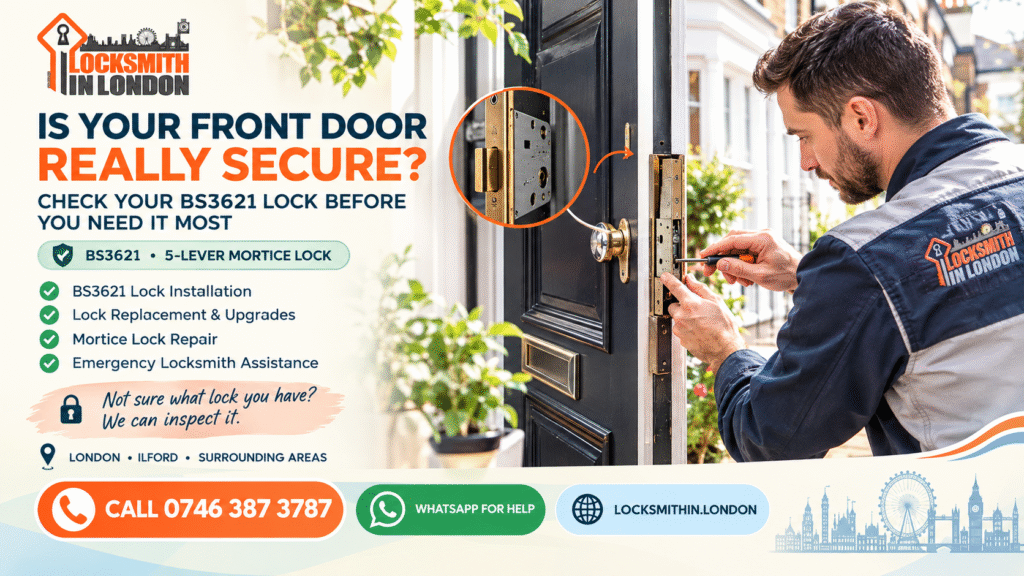
BS3621 Lock London: What Homeowners Need to Know in 2026
BS3621 Lock London is an important search for homeowners who want to understand British Standard locks, improve door security or check whether their existing lock may need replacing.
As of 2026, the current published version is BS 3621:2017+A1:2024, which covers thief-resistant mechanically operated single-point lock assemblies operated by key from both sides. The standard covers more than just the visible lock body; its scope includes elements such as the locking plates, fixing screws, cylinders and protective furniture where appropriate.
For London homeowners, landlords and businesses, the important question is not simply “Is my lock old?” but rather:
Does my existing lock provide the right level of security for my door, property and insurance requirements?
If you need professional advice, lock replacement or an urgent security upgrade, Locksmith In London provides residential and commercial locksmith services across London, with 24/7 emergency assistance and fast-response support.
Table of Contents
What Is a BS3621 Lock?
A BS3621 lock is a thief-resistant mechanical single-point lock assembly operated by key from both the inside and outside.
The British Standards Institution describes BS 3621 as a standard covering lock assemblies that incorporate a suitable lock and are designed for doors, window doors and entrance doors in buildings.
This is why you will often hear BS3621 mentioned alongside terms such as:
- British Standard lock
- 5-lever mortice deadlock
- insurance-approved lock
- high-security mortice lock
- security door lock
However, homeowners should not assume that every five-lever lock automatically meets BS3621.
Look for the appropriate certification or marking and check the exact product specification.
The Master Locksmiths Association also provides consumer information explaining how BS3621 locks can be identified and what the standard means.
What Does BS3621 Mean in 2026?
The important 2026 update is that the current BSI publication is BS 3621:2017+A1:2024.
It was published in September 2024 and remains the current version listed by BSI.
That matters because older articles may simply refer to “BS3621:2007” or “BS3621:2017”.
When researching a replacement in 2026, it makes sense to check the current standard and the exact product certification rather than relying on an old blog post or product description.
The BSI database is the appropriate place to verify the current standard information.
Where Are BS3621 Locks Used?
BS3621 locks are commonly associated with wooden external doors and mortice-style locking systems.
They can be particularly relevant to traditional London properties where timber entrance doors use a mortice lock.
The Metropolitan Police advises homeowners to check whether their locks and other door-security components meet appropriate British Standards.
The police guidance also highlights the importance of considering the complete door security arrangement rather than viewing the lock as an isolated component.
For new residential construction, GOV.UK Approved Document Q provides statutory guidance concerning reasonable provision against unauthorised access to new dwellings in England.
Seven Things London Homeowners Should Check
1. Check What Type of Lock You Already Have
Before ordering a replacement, identify the existing locking system.
Is it a mortice deadlock?
Is it a sashlock?
Is it a night latch?
Or does your door use a multipoint mechanism?
A BS3621 solution is not automatically suitable for every door.
The Secured by Design guidance distinguishes between BS3621, BS8621, BS10621 and other locking standards because they provide different operating and egress arrangements.
This is one reason professional assessment can be useful before purchasing a replacement.
2. Look for the British Standard Marking
A genuine compliant product should have appropriate identification or certification information.
Don’t rely solely on phrases such as:
“High Security”
or
“Insurance Approved.”
Ask what standard the actual product meets.
The Master Locksmiths Association BS3621 guide explains the identification and certification considerations for British Standard locks.
If you’re unsure what is currently fitted to your door, a locksmith can inspect the lock and explain the options.
3. Check the Door, Frame and Furniture
A strong lock cannot compensate for every weakness elsewhere in a doorset.
The condition of the door, frame, hinges, keeps, strike area and surrounding construction can all affect security.
The NPSA recommends looking at doors, frames and other physical-security elements as part of a wider assessment.
Similarly, the Metropolitan Police recommends considering the overall security of doors and windows rather than concentrating on a single component.
4. Check Your Insurance Requirements
This is an important point for homeowners.
Some insurance policies specify particular lock standards or security arrangements.
That does not mean every UK home must have a BS3621 lock.
Your own policy wording is what matters.
Which? notes that insurers can require minimum security measures and that five-lever mortice deadlocks conforming to BS3621 are preferred by insurers.
Before replacing a lock for insurance reasons, check your policy or ask your insurer exactly what is required.
For general consumer insurance guidance, Citizens Advice also provides information about buildings insurance.
5. Check Whether the Lock Is Worn or Damaged
Security isn’t only about certification.
A British Standard lock that is badly worn, damaged or difficult to operate may need professional attention.
Watch for warning signs such as:
- Key becoming difficult to turn
- Bolt not extending smoothly
- Handle or sash mechanism becoming loose
- Lock sticking
- Door needing excessive force
- Visible damage around the lock
- Key becoming difficult to remove
A small fault can become a much bigger problem if the mechanism eventually fails.
If the door is becoming unreliable, arranging a professional inspection can be more convenient than waiting for an emergency.
6. Check Whether You Need a Different Locking Arrangement
BS3621 is not the only relevant standard.
For example, Secured by Design lists BS8621 for keyless egress and BS10621 for dual-mode operation, alongside BS3621 for key-operated egress.
This distinction can matter in flats, apartment buildings and properties where means of escape is an important consideration.
Don’t automatically replace one lock with another without considering how occupants leave the property in an emergency.
If you are changing a lock on a communal or fire-sensitive door, additional requirements may apply.
7. Consider the Whole Security Upgrade
A new BS3621 lock can be useful, but homeowners should consider whether other weaknesses remain.
For example, you may also need to review:
- Door condition
- Frame strength
- Cylinder security where applicable
- Hinges
- Letterbox position
- Secondary doors
- Accessible windows
- Patio doors
- Lighting
- Door viewers or access controls
The Metropolitan Police recommends double-locking doors and also provides specific guidance on euro cylinders and modern multipoint doors.
For London homeowners, the Redbridge Council burglary guidance is another useful local resource covering doors, windows, keys and locking practices.
BS3621 vs Other Door Lock Standards
Choosing a lock becomes easier when you understand that different standards address different requirements.
| Standard | General purpose |
|---|---|
| BS3621 | Key-operated single-point lock assembly with key egress |
| BS8621 | Keyless egress from inside |
| BS10621 | Dual-mode arrangement with a deliberate secure mode |
| TS007 | Enhanced security requirements for replacement cylinders and associated hardware |
| SS312 Diamond | Enhanced security standard for cylinders |
The Secured by Design standards guide provides an overview of these different security specifications.
The important point is simple:
The “best” lock depends on the door, the property and the security requirement.
When Should You Replace a British Standard Lock?
A replacement may be worth considering if the existing lock is damaged, repeatedly failing or no longer appropriate for the property.
It can also make sense after moving into a new home if you are uncertain how many people may have copies of the old keys.
The Master Locksmiths Association recommends considering the type of lock, manufacturer, location and time of service when assessing replacement work.
Locksmith In London also provides dedicated Lock Replacement London services covering residential and commercial requirements.
If the problem is damage rather than age, repair may be possible.
The company’s Lock Repair Central London service explains that some faulty locks can be repaired rather than immediately replaced.
BS3621 Lock London Pricing Guide By locksmith in London ltd
Locksmith prices vary according to the product, door type, labour, location, time and complexity.
The Master Locksmiths Association currently lists indicative product prices of around £38 from for a BS3621 mortice deadlock, £40 from for a BS3621 mortice sashlock and around £100 from for a BS3621-approved night latch. These are product estimates rather than a complete installed-service quotation.
For broader London locksmith work, Checkatrade’s current London pricing data gives a London locksmith-service range of approximately £122–£219, with an average of £162, while emergency locksmith services are listed at approximately £104–£189.
| Service | Indicative guide |
|---|---|
| BS3621 mortice deadlock product | From about £38 |
| BS3621 mortice sashlock product | From about £40 |
| BS3621 night latch product | From about £100 |
| London locksmith service | £122–£219 |
| London emergency locksmith service | £104–£189 |
| Installation | Depends on door, product and labour |
These figures are guides, not fixed quotations.
For comparison, Locksmith In London’s current pricing page lists British Standard lock options, including an ERA British Standard lock from £48.99 and a Union British Standard lock at £88.99; confirm the current price and suitability before booking.
Checkatrade’s 2026 locksmith cost guide also explains that time of day, lock type, materials and location can affect the final price.




Emergency Locksmith London Assistance
A lock problem doesn’t always happen during office hours.
A failed deadlock at night, a damaged door after an attempted break-in or a lost key can turn a normal evening into an urgent security problem.
Locksmith In London provides 24/7 emergency locksmith assistance and states that it aims for fast response across London and surrounding areas.
If you are locked out, don’t force the door or attempt improvised methods that could damage the lock, frame or door.
Instead, explain the situation clearly when calling.
Tell the locksmith whether:
- You are locked outside
- The key is lost
- The key has snapped
- The lock is damaged
- The door will not lock
- You need a BS3621 upgrade
- The property has recently been purchased
For emergency service:
How to Choose a Locksmith Near Me
Searching locksmith near me is usually the first step when a lock fails.
However, proximity should not be the only consideration.
Look for clear communication, transparent pricing, relevant experience and a locksmith who can explain why a particular lock is being recommended.
Checkatrade provides a directory of London locksmiths and cost information, while Trustpilot and Yell can provide additional places to research businesses and customer feedback.
The Master Locksmiths Association also provides industry and consumer information about locksmith services.
Locksmith In London currently advertises certified locksmiths, fully insured services, fast response and 24/7 emergency support on its website.
Always ask what product is being supplied, what standard it meets and what the quoted price includes.
How to Improve London Home Security
A lock is only one part of your property’s security.
The NPSA recommends assessing doors, windows, patio doors and other potential vulnerabilities as part of a broader physical-security approach.
For new residential developments, GOV.UK provides guidance on security in dwellings.
The Metropolitan Police also provides extensive home-security guidance for London residents.
For product information, homeowners can research manufacturers such as Yale Home, ASSA ABLOY and Master Lock.
The British Security Industry Association provides wider information about the UK security industry.
For London-specific safety information, London.gov.uk and Redbridge Council can also be useful.
For general news and consumer awareness, BBC and the Evening Standard provide London-focused information, although homeowners should use specialist security sources for technical lock standards.
Why Choose Locksmith In London?
When a security problem occurs, customers usually want three things:
Fast response.
A suitable solution.
Clear information before work begins.
Locksmith In London provides residential and commercial locksmith services across London and surrounding areas, including lock repair, replacement, emergency entry and security upgrades.
You can also explore the company’s High Security Lock Installation service if you are considering a wider security upgrade.
For residential requirements, the Residential Locksmith Services Central London page covers lock repairs, replacements, security upgrades and emergency assistance.
If you need an urgent solution, don’t wait until a worn or damaged lock becomes a complete failure.
Frequently Asked Questions
Is a BS3621 Lock London suitable for every property?
No. BS3621 applies to a specific type of key-operated single-point lock assembly. The correct solution depends on the door, locking arrangement, escape requirements and security objectives.
Are BS3621 locks required by home insurance?
Not universally. Some insurers specify minimum security requirements and may require particular lock standards. Check your individual policy before replacing a lock specifically for insurance purposes.
What is the difference between BS3621 and a normal mortice lock?
BS3621 refers to a tested standard for a particular type of thief-resistant lock assembly. A generic mortice lock should not automatically be assumed to meet BS3621.
Can a locksmith replace a BS3621 lock?
Yes. A locksmith can assess the existing door, measure the lock and recommend a suitable replacement where appropriate.
Are BS3621 locks suitable for uPVC doors?
BS3621 is primarily associated with single-point key-operated lock assemblies, whereas many modern uPVC doors use multipoint locking systems. Other standards and cylinder specifications may be more appropriate depending on the door.
How much does a BS3621 lock cost in London?
Product prices vary significantly. The MLA currently lists BS3621 products from around £38 for some mortice deadlocks, while the total installed price depends on the product, door and labour. London locksmith service prices are generally higher for urgent or complex work.
What should I do if my British Standard lock suddenly fails?
Avoid forcing the key or door. Contact an emergency locksmith London service, explain the failure and ask for an assessment. If the lock cannot be repaired safely, replacement may be necessary.
Get Your Door Security Checked Before the Lock Fails
A lock rarely chooses a convenient time to fail.
The key may become stiff gradually. The bolt may start sticking. The door may need more force to close.
Those small signs are worth paying attention to.
If you’re unsure whether your current BS3621 Lock London installation is suitable, damaged or outdated, professional assessment can help you understand your options before the problem becomes an emergency.
Need a BS3621 lock replacement or security upgrade?
24/7 Emergency Locksmith • London • Ilford • Surrounding Areas
Areas We Cover
- locksmith in Camden
- Locksmith in Westminster
- Locksmith in Loughton
- Locksmith in Chigwell
- Locksmith in London Epping Forest Distric
If you’re unsure whether we cover your area, simply give us a call.