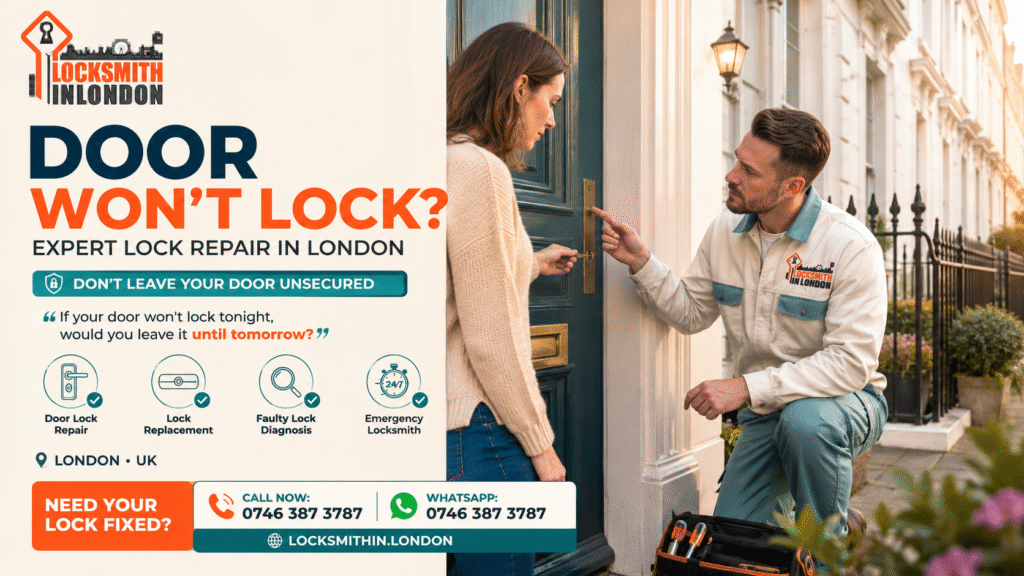
Door Won’t Lock London? 8 Problems That Could Put Your Home at Risk
door won’t lock London problems can be frustrating, especially when you are trying to secure your home, flat, office or rental property. A Door Closer Repair that suddenly refuses to lock may have a simple mechanical fault, but it can also indicate a worn cylinder, damaged mechanism, alignment problem or issue with the door frame.
If your door will not lock properly, do not ignore it.
A functioning lock is an important part of your property’s physical security. The Metropolitan Police advises residents to keep doors secure and check that locks are properly engaged.
If you need professional assistance, Locksmith In London provides lock repair, lock replacement and emergency locksmith services across London.
Table of Contents
What Does It Mean When Your Door Won’t Lock?
A door may fail to lock for several different reasons.
Sometimes the key turns but the bolt does not move. In other cases, the key refuses to turn, the handle feels loose, the latch does not enter the keep, or the door only locks when you lift or push it.
These symptoms can point to different problems.
For example, a door that suddenly becomes difficult to lock may have developed alignment issues. A key that turns without engaging the mechanism could indicate an internal lock problem.
The important point is simple:
Do not assume that replacing the key will solve every lock problem.
A professional inspection can help identify whether the issue involves the cylinder, multipoint mechanism, hinges, strike plate, door frame or internal hardware.
8 Common Reasons Your Door Won’t Lock
1. The Door Is Misaligned
One of the most common problems is door misalignment.
If a door has dropped slightly, moved within its frame or developed hinge problems, the locking points may no longer line up correctly with the keeps.
You might notice that the door closes normally but will not lock unless you push, pull or lift it.
This is particularly relevant to Emergency UPVC Window Lock Repair and composite doors with multipoint locking systems.
Possible solution: A professional locksmith can inspect the alignment and determine whether adjustment or lock repair is appropriate.
2. The Lock Cylinder Is Worn
Lock cylinders experience regular use.
Over time, internal components can wear. The key may become increasingly difficult to turn, or the cylinder may stop engaging correctly.
A worn cylinder can sometimes provide warning signs before complete failure.
Watch for:
- Increasingly stiff key operation
- Key Won’t Turn in Lock London movement becoming inconsistent
- Difficulty removing the key
- Lock only working from one side
- Intermittent locking
If these symptoms are appearing, getting the problem assessed early may prevent a more inconvenient lockout later.
The Metropolitan Police also recommends considering appropriately rated euro cylinders when upgrading certain Door Lock Keeps Turning London.
3. The Multipoint Locking Mechanism Is Faulty
Many modern London homes use uPVC or composite doors fitted with multipoint locking systems.
These systems can use several locking points along the edge of the door.
If the internal mechanism develops a fault, the handle may become stiff or the locking points may fail to engage.
Do not force the handle repeatedly.
A specialist can inspect the mechanism and determine whether repair or replacement is more appropriate.
4. The Strike Plate or Keep Is Misaligned
The metal component attached to the frame that receives the latch or bolt must line up correctly.
If it moves, becomes loose or was incorrectly positioned, the locking mechanism may not engage.
This can create a situation where the door appears closed but cannot actually lock.
A locksmith can assess the relationship between the door, frame and locking points.
5. The Door or Frame Has Swollen or Shifted
Changes in temperature, moisture and building movement can affect doors and frames.
Timber doors can expand or contract. Other doors can shift slightly due to regular use, hinge movement or frame problems.
As a result, the lock may work perfectly when the door is open but fail when the door is closed.
That distinction is useful.
Quick check
If the lock operates normally while the door is open but fails when the door is closed, alignment could be part of the problem.
Avoid repeatedly forcing the mechanism.
6. The Key Is Damaged or Incorrect
Sometimes the lock is not the problem.
A worn, bent or incorrectly cut key can prevent the mechanism from operating properly.
Try a known-working spare key if you have one.
However, avoid repeatedly twisting a damaged key because it could break inside the cylinder.
If the key has already snapped or become stuck, professional stuck-key assistance may be required.
7. The Internal Lock Mechanism Has Failed
A lock can fail internally even when there is no obvious external damage.
The handle may move without engaging the latch. The key may rotate freely. Or the lock may suddenly stop working altogether.
Internal failures can be difficult to diagnose without removing or inspecting the relevant hardware.
This is where professional lock repair can be more appropriate than guessing which part needs replacing.
8. The Door Has Been Damaged
Impact, attempted forced entry, accidental damage or deterioration can affect the door and its locking hardware.
If you notice visible damage around the lock, frame or door, treat the problem seriously.
The Metropolitan Police recommends maintaining secure doors and windows because they form important points of entry to a property.
If the property has been damaged following an incident, securing the opening should take priority.
Can You Safely Fix a Door Lock Yourself?
Some basic checks are reasonable.
You can check whether:
- The door is properly closed.
- The key is the correct one.
- A spare key works.
- The handle is operating normally.
- There is visible obstruction around the latch.
- The hinges or frame appear obviously loose.
However, avoid dismantling the locking mechanism if you are unsure what you are doing.
A small mistake can turn a repairable issue into a complete lock failure.
More importantly, never compromise your property’s High Security Lock Installation simply to get the door closed temporarily.
For independent security guidance, the Metropolitan Police door security advice provides useful information about securing residential doors.
You can also review Secured by Design security guidance when considering security improvements.
When Should You Call a Locksmith?
If the problem prevents you from properly securing your property, professional assistance is sensible.
Consider calling a locksmith when:
- The door will not lock at all.
- The key will not turn.
- The key is stuck.
- The lock turns without engaging.
- The door only locks when forced.
- A uPVC multipoint mechanism is malfunctioning.
- The lock has suffered damage.
- You have been locked out.
- You need an urgent lock replacement.
For a door lock repair London search, look for a provider that can explain the problem clearly and give you a quote before unnecessary work begins.
For consumer information, Citizens Advice provides general guidance on consumer rights and dealing with services.
Door Lock Problems in London Flats and Houses
London properties vary enormously.
A Victorian terrace may use a traditional mortice lock. A modern apartment might use a euro cylinder or electronic access system. A newer development may use a composite or uPVC door with multipoint locking.
Therefore, the correct solution depends on the door and hardware.
For flats, communal entrances also deserve attention.
The Metropolitan Police advises residents that communal doors should close and remain secure, and problems should be reported to the managing agent or landlord promptly.
If you manage a block of flats, don’t ignore a communal door that fails to lock.
One faulty entrance can affect everyone using the building.
uPVC Door Won’t Lock? Here’s What to Check
uPVC doors Lock can produce a particularly confusing set of symptoms.
You may find that:
The handle won’t lift.
This could indicate an issue with the multipoint mechanism, alignment or internal hardware.
The handle lifts but the key won’t turn.
The locking points may not be correctly aligned with the frame.
The key turns but the door remains unsecured.
The cylinder or internal mechanism could require inspection.
The Metropolitan Police specifically advises owners of modern multipoint and uPVC doors to use the locking system correctly, including lifting the handle and turning the key where applicable.
If the mechanism feels unusually stiff, don’t repeatedly force it.
Emergency Locksmith London: When the Problem Can’t Wait
Some lock problems happen at the worst possible time.
You may discover the problem when leaving for work, returning home late at night or preparing to close a business.
If your property cannot be secured, the situation becomes more urgent.
Locksmith In London offers Emergency Locksmith Loughton assistance for customers dealing with urgent lock problems across London.
If there is an immediate threat to someone’s safety or an active crime, contact the emergency services rather than relying on a Emergency Locksmith Epping Forest District: Fast Help When You Need It.
The Metropolitan Police states that emergencies should be reported via 999 or 112.
Door Lock Repair vs Lock Replacement
Not every faulty lock needs complete replacement.
A repair may be appropriate when the underlying hardware is serviceable and the problem can be corrected.
Replacement may make more sense when the cylinder or mechanism is worn, damaged or no longer suitable for the property’s security requirements.
Repair may be suitable when:
The hardware is generally sound but has an identifiable mechanical or alignment issue.
Replacement may be suitable when:
The lock is damaged, worn beyond practical repair or needs upgrading.
A professional assessment can help determine the most appropriate option.
For broader product and security guidance, homeowners can also review information from Yale Home UK and ASSA ABLOY.
Door Lock Pricing Guide in London
The final cost of a Lock Repair Central London or replacement depends on the actual problem.
There is no responsible single price that applies to every property.
| Service | Typical Cost Factors |
|---|---|
| Lock inspection | Problem diagnosis, property type and access |
| Lock repair | Fault, mechanism and labour required |
| Cylinder replacement | Cylinder specification and hardware |
| Multipoint lock repair | Mechanism type and replacement parts |
| Lock replacement | Lock standard, door type and hardware |
| Emergency attendance | Time, location, urgency and work required |
A transparent locksmith should explain the work required before carrying out chargeable repairs.
For general business and consumer comparisons, you can also consult Checkatrade and Yell.




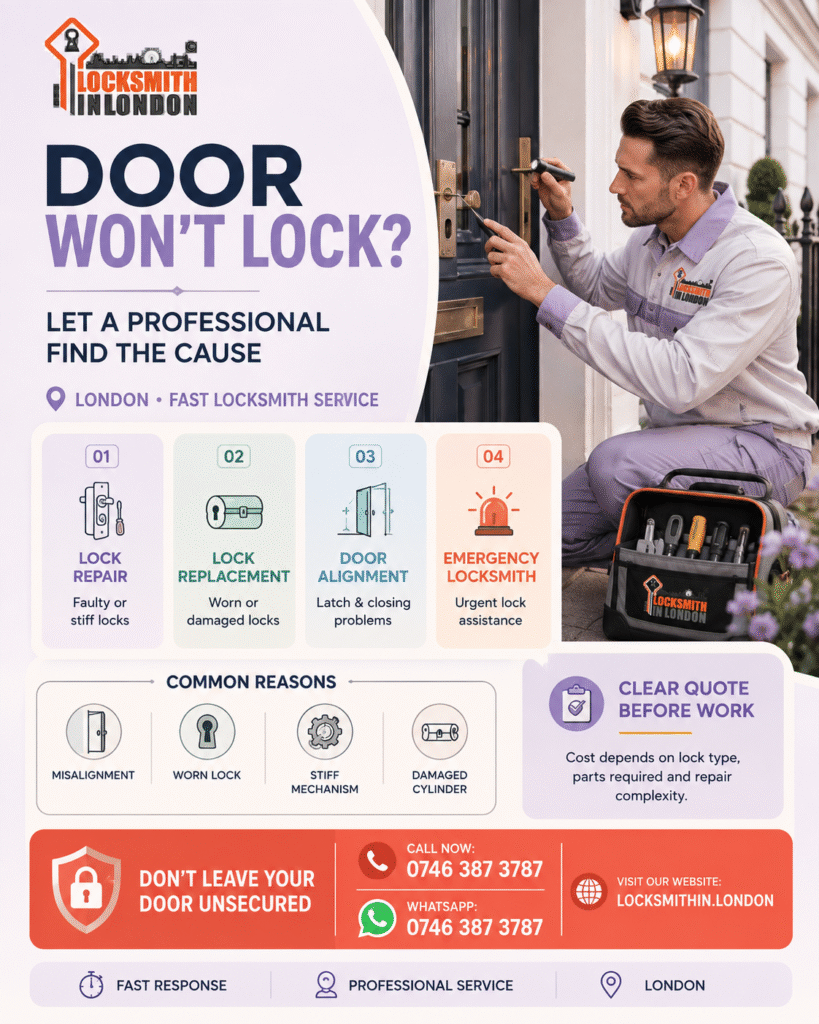
How to Improve Your Door Security
ixing today’s lock problem is only one part of good property security.
Start with the basics.
Make sure your doors and windows close properly and that locks are used consistently.
The Metropolitan Police recommends double-locking appropriate doors and considering security-rated lock upgrades where suitable.
For additional security information, useful resources include:
- UK Government
- London City Hall
- Which?
- British Standards Institution
- British Security Industry Association
- Master Locksmiths Association
- Secured by Design
These resources can help property owners understand broader security considerations.
Why Choose Ilford locksmith?
When a door cannot be secured, you need a solution rather than a sales pitch.
Locksmith In London provides professional locksmith services for residential and commercial customers throughout London.
The service focus includes:
1 24/7 Emergency Locksmith Services | Locksmith in London
Urgent assistance for lock-related problems. call Emergency Locksmith Loughton – 7 Reliable Services
Lock Repair
Diagnosis and repair of suitable faulty locking hardware.
Lock Replacement
Replacement of worn or damaged locks.
High-Security Lock Upgrades
Security-focused options for properties requiring upgraded hardware.
uPVC Door Locks
Assistance with common uPVC and multipoint lock problems.
Commercial Locksmith Services
Support for offices, shops, landlords and business premises.
For service information, visit Locksmith In London.
What to Do If Your Door Won’t Lock
If you’re standing in front of a door that suddenly refuses to lock, don’t panic.
First, stop forcing the key or handle.
Next, check whether the problem occurs with the door open or only when it is closed.
If you have a spare key, you can carefully test it.
If the problem continues, professional diagnosis is usually safer than repeatedly forcing the mechanism.
Need urgent help?
Frequently Asked Questions
Why won’t my door lock?
Common causes include door misalignment, a worn cylinder, damaged internal mechanism, faulty multipoint hardware, loose strike plates or problems with the key.
If the lock works with the door open but not when closed, alignment may be worth checking.
Can I force a door lock that won’t lock?
It is better not to force it.
Excessive pressure can damage the key, cylinder, handle or internal mechanism. If the door cannot be secured, professional assistance can help identify the underlying fault.
Why won’t my uPVC door lock?
A uPVC door may fail to lock because of alignment problems, a faulty multipoint mechanism, worn hardware or an issue with the cylinder.
If the handle or key suddenly becomes stiff, avoid forcing it.
Should I repair or replace my door lock?
That depends on the condition of the hardware.
A repair may be appropriate when the mechanism remains serviceable. Replacement can be more suitable when the lock is damaged, excessively worn or requires a security upgrade.
Can a locksmith repair a door that won’t lock?
Yes, depending on the cause.
A locksmith can inspect the lock, cylinder, mechanism, alignment and associated hardware before recommending an appropriate repair or replacement.
How much does door lock repair cost in London?
There is no universal price because costs depend on the lock type, parts, labour, access and urgency.
Ask for a clear quote before work begins.
What should I do if my door won’t lock at night?
Avoid leaving the property unsecured. If you cannot safely secure the door, contact an Emergency Locksmith Ilford – Expert 24/7 Door Opening Services for assistance.
If there is an immediate danger or active crime, contact emergency services on 999 or 112.
Final Door Security Checklist
Before leaving your London property, check:
- Door closes correctly
- Lock engages properly
- Key turns normally
- Handles operate correctly
- No unusual stiffness
- No visible damage
- uPVC multipoint mechanism operates correctly
- Accessible windows are secured
- Spare keys are stored safely
The Metropolitan Police emphasises that secure doors and windows are important elements of protecting a property.
If something suddenly feels different, don’t wait until the lock completely fails.
Need Help With Your Lock? Call 24/7 locksmith London
A door that won’t lock is more than an inconvenience. It can leave your home, flat, office or commercial property unsecured.
If you’ve tried the basic checks and the problem remains, contact Locksmith In London for professional assistance.
Don’t wait for a lock problem to become a lockout.
Areas We Cover
- locksmith in Camden
- Locksmith in Westminster
- Locksmith in Loughton
- Locksmith in Chigwell
- Locksmith in London Epping Forest District
If you’re unsure whether we cover your area, simply give us a call.