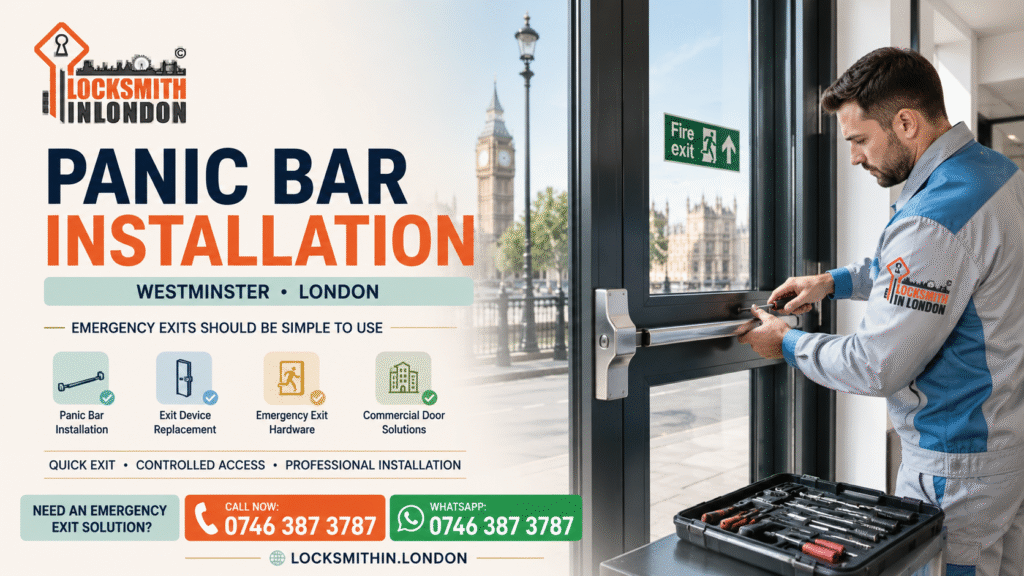
Panic Bar Installation Westminster – Expert 2026 Fire Safety Guide
Panic Bar Installation Westminster is an important consideration for offices, schools, shops and commercial buildings where people may need to leave quickly during an emergency.
The right exit hardware can help occupants operate an escape door quickly while maintaining appropriate access control when the building is occupied. However, the correct product and installation depend on the door, building use, occupancy, fire strategy and risk assessment.
For businesses in Westminster, getting the escape-door arrangement right is more than a hardware decision. It should form part of a properly managed fire-safety strategy.
If you need professional commercial door assistance, contact Locksmith In London on 0746 387 3787 or use WhatsApp for an initial discussion.
Table of Contents
What Is a Panic Bar?
A panic bar is a horizontal exit device fitted to a door so people can operate the exit mechanism by pushing a bar.
This design is particularly useful where occupants may not be familiar with the building or may need to leave quickly during an emergency.
The UK Government’s fire-safety guidance for offices and shops explains that final exit doors should be quickly and easily openable without a key or code during a fire. It also discusses panic exit bar devices for premises where members of the public or other unfamiliar users may be present.
The principle is simple:
Push → Release → Exit
That simplicity is one reason panic hardware is widely associated with escape routes in public-facing and commercial premises.
However, a panic bar should never be selected simply because it looks appropriate. The complete doorset, locking arrangement, fire performance, escape strategy and building use need to be considered.
Why Panic Exit Hardware Matters
Imagine an emergency inside a busy office.
People may be unfamiliar with the building. Visitors may not know which door to use. Staff may be moving quickly towards an exit.
In that situation, complicated locking mechanisms can create unnecessary obstacles.
The purpose of suitable escape hardware is to make the exit operation intuitive while maintaining the required level of security and fire-safety performance.
Government guidance states that escape routes should remain usable and available whenever premises are occupied. It also says that final exit doors should be quickly and easily openable without a key or code during a fire.
That makes the condition and suitability of exit hardware an important part of commercial property management.
For a Westminster business owner, facilities manager or landlord, the question should therefore be:
“Can everyone who may need to escape operate this exit quickly and safely?”
If the answer is uncertain, the door should be assessed by an appropriate competent person.
Westminster Fire Safety Responsibilities
Fire safety responsibilities in England are governed by the Regulatory Reform (Fire Safety) Order 2005, alongside subsequent legislation and regulations.
The responsible person for a premises has duties relating to fire-risk management and appropriate fire precautions. London Fire Brigade explains that responsible persons should ensure a suitable fire-risk assessment is completed and that fire-safety precautions are maintained.
GOV.UK – Regulatory Reform Fire Safety guidance
London Fire Brigade – Fire Safety at Work
London Fire Brigade – Advice for Responsible Persons
Westminster businesses can also refer to the local authority’s business safety and contingency guidance, which directs businesses towards London Fire Brigade for fire-safety information.
Westminster City Council – Business Safety Guidance
Fire Risk Assessment Comes First
A panic bar should not be treated as a standalone compliance shortcut.
The appropriate exit arrangement should be considered within the wider fire-risk assessment and building strategy.
The Government explains that the responsible person must identify fire risks and take appropriate action.
GOV.UK – Fire Safety Responsibilities
GOV.UK – Fire Safety Act 2021
This is particularly important when changing existing fire doors, exit devices, access-control systems or other door hardware.
BS EN 1125 and Emergency Exit Hardware
One of the most important technical considerations is the distinction between panic hardware and emergency exit hardware.
BSI describes BS EN 1125 as covering panic exit devices operated by a horizontal bar for use on escape routes.
BSI – BS EN 1125 Panic Exit Devices
BS EN 179 covers emergency exit devices operated by a lever handle, push pad or similar arrangement and is generally associated with situations where users are familiar with the building and its escape arrangements.
ASSA ABLOY’s technical guidance explains the distinction between EN 179 emergency hardware and EN 1125 panic hardware, including the relevance of user familiarity and public-access environments.
ASSA ABLOY – Panic & Emergency Exit Hardware
The correct standard therefore depends on the specific application.
Do not select a device solely because the packaging says “panic bar”.
A competent installer should consider:
- Door type and dimensions
- Single or double-leaf doors
- Fire-door requirements
- Occupancy
- Public or staff-only access
- Escape-route configuration
- External access requirements
- Existing locks and cylinders
- Access-control integration
- Manufacturer instructions
- Applicable standards
Panic Bars for Offices, Schools and Commercial Buildings
Different premises have different escape requirements.
Offices
Keyless entry system Modern offices can contain open-plan workspaces, meeting rooms, reception areas and restricted departments.
Final exits may need to balance security with rapid escape.
A suitable panic or emergency exit arrangement can help create a straightforward escape operation while allowing appropriate access control.
Schools
Schools have additional considerations because occupants can include children, visitors, teachers and contractors.
Escape hardware should be selected as part of the school’s wider fire-risk and evacuation strategy.
GOV.UK – Fire Safety Risk Assessment Guidance
Shops and Public Buildings
Retail environments can have customers who have never visited the building before.
Government guidance specifically discusses panic bar devices for premises where members of the public or other unfamiliar users may be present.
That makes intuitive operation especially important.
Panic Bar Installation Process By Ilford locksmith
A professional installation should begin with an assessment rather than immediately drilling holes into the door.
1. Door Assessment
The installer examines the door leaf, frame, hinges, existing lock, closing system and surrounding hardware.
2. Escape Requirements
The installer considers how the door is being used and whether it forms part of an escape route.
3. Hardware Selection
The appropriate panic or emergency exit device is selected for the doorset and intended application.
4. Positioning
The hardware is positioned according to the manufacturer’s installation requirements.
5. Installation
The device is securely fitted and connected to the appropriate locking mechanism.
6. Testing
The completed installation should be checked for smooth operation, secure engagement and appropriate release.
7. Final Inspection
The complete door arrangement should be assessed rather than looking at the panic bar in isolation.
For fire doors, alterations and replacement work should be undertaken by appropriately competent people. Government guidance stresses that fire doors need to remain in good working order and repair.
GOV.UK – Fire Door Guidance
Fire Doors and Panic Bars: Why the Combination Matters
A common mistake is to focus on the panic bar while ignoring the rest of the doorset.
A fire-resisting door is part of a wider system.
The Government’s current fire-door guidance explains that fire doors should be maintained in good working order and that defects should not materially undermine their ability to resist fire and smoke spread.
For certain multi-occupied residential buildings in England, the Fire Safety (England) Regulations 2022 also require regular checks of relevant fire doors and self-closing devices.
GOV.UK – Fire Safety (England) Regulations 2022
Legislation.gov.uk – Fire Safety (England) Regulations 2022
This means replacing or adding hardware should be approached carefully.
The door, closer, hinges, seals, lock, exit device and frame may all interact.
Common Panic Bar Problems
Even a correctly selected device can develop problems through heavy use, impact, wear or poor adjustment.
Common warning signs include:
The bar feels stiff.
The mechanism may require inspection or adjustment.
The door does not release correctly.
The locking points or internal mechanism may need attention.
The door will not latch properly.
Alignment, strike position, door movement or the locking mechanism may need checking.
The door is difficult to open.
Excessive resistance can make an escape door less intuitive to operate.
The external access device is not working.
Some exit doors require controlled access from outside while retaining appropriate escape functionality from inside.
The door no longer closes correctly.
The door closer, hinges, frame alignment or other hardware may require inspection.
Do not simply remove, bypass or disable exit hardware because it feels inconvenient. Changes to an escape door can affect the wider fire-safety strategy.
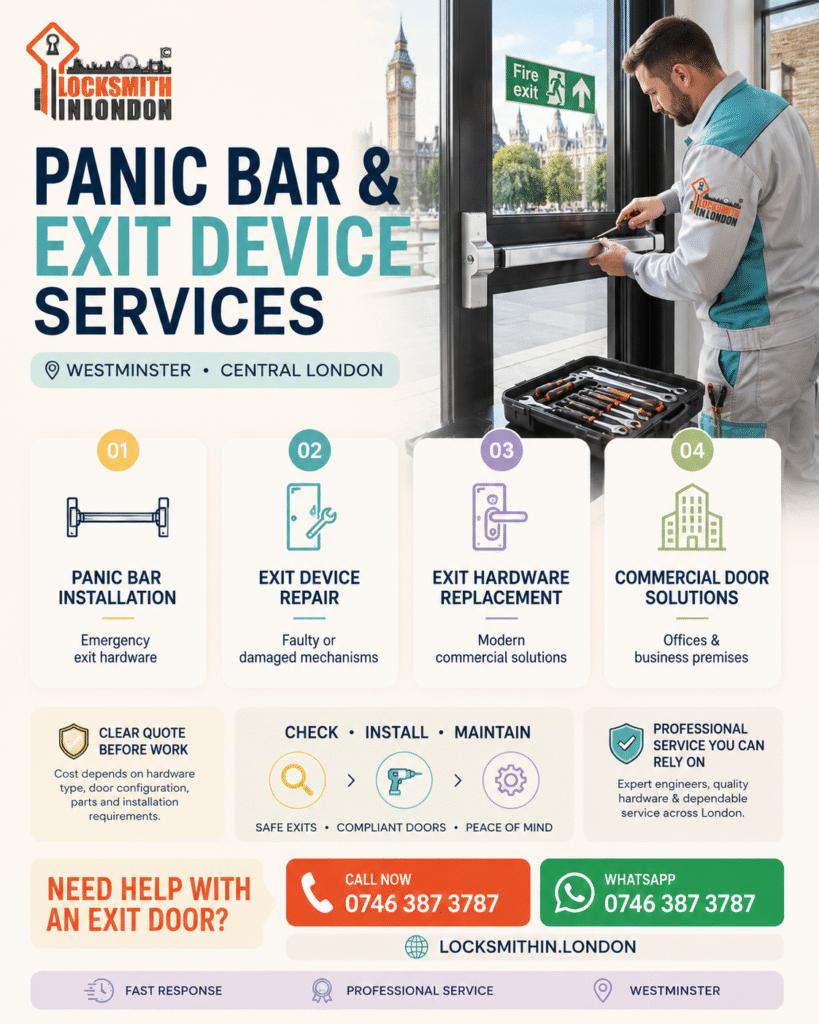
Panic Bar Installation Westminster Pricing Guide
There is no responsible one-size-fits-all price for commercial exit hardware.
The final cost can depend on the existing doorset, hardware specification, number of doors, fire-door requirements, access-control integration, replacement parts and installation complexity.
| Service | Typical pricing approach |
|---|---|
| Site assessment | Quote based on premises and requirements |
| Single panic-bar installation | Quote after door and hardware assessment |
| Panic-bar replacement | Depends on existing device and replacement specification |
| Emergency exit hardware repair | Depends on fault and parts required |
| Multiple commercial doors | Site survey and project quotation |
| Access-control integration | Depends on existing system and compatibility |
| Fire-door hardware upgrade | Quote based on doorset and required specification |
Why Avoid Unrealistic “Cheap Panic Bar” Prices?
A commercial escape door is not the place to choose hardware solely because it has the lowest Locksmith pricing.
The correct solution should consider the complete door and its intended use.
For product information and technical specifications, manufacturers such as ASSA ABLOY publish information about panic and emergency exit hardware and applicable standards.
ASSA ABLOY – Panic & Emergency Hardware
Master Lock – Official Website
Yale Home UK – Official Website
How to Choose a Locksmith in London for Commercial Exit Doors
When searching online for a commercial locksmith, don’t choose based only on the first advertisement you see.
Ask practical questions.
Can the installer explain which hardware is appropriate for the application?
Can they assess the existing doorset?
Do they understand the difference between panic and emergency exit devices?
Can they explain what work is required before starting?
Can they provide a clear quotation?
Can they explain what testing will be performed after installation?
Industry and consumer resources can also help when comparing tradespeople.




Which? – Consumer Advice
Citizens Advice – Consumer Advice
Locksmiths.co.uk – Locksmith Information
For security considerations, you can also explore guidance from:
Secured by Design
British Security Industry Association
What About a 24/7 Locksmith London Service?
Commercial door problems do not always happen during convenient working hours.
A damaged exit device, failed lock or malfunctioning door can create an urgent access or security issue.
If you are searching for a 24/7 locksmith London service, explain the exact problem when you call. Tell the locksmith whether the door is a fire door, final exit, emergency exit, internal commercial door or access-controlled entrance.
For urgent locksmith assistance, contact Locksmith In London on:
Send the door type, location, photographs if appropriate and a short description of the problem.
Emergency Locksmith London Services for Commercial Properties
A commercial locksmith may assist with a range of door-security requirements alongside exit hardware.
Depending on the property and service availability, these can include commercial lock repairs, door lock replacement, access-control hardware, office lockouts, high-security locks and other commercial door solutions.
If you’re looking for an Emergnecy Locksmith Ilford, the same principle applies: explain the exact door problem and intended use before arranging work.
A professional assessment is particularly important where a door forms part of an escape route or fire-safety arrangement.
For broader London security information, businesses can also consult:
London.gov.uk
London Fire Brigade – Workplace Fire Safety
GOV.UK – Fire Safety Enforcement and Sanctions
7 Signs Your Panic Bar Needs Professional Attention
A quick visual check can help identify obvious warning signs.
1. The bar feels unusually stiff
Do not force it. The mechanism may require inspection.
2. The door does not release smoothly
This can indicate a problem with the latch, bolts, alignment or internal mechanism.
3. The door fails to close correctly
A panic bar is only one part of the doorset.
4. The latch does not engage
The door may not secure correctly when closed.
5. Hardware is visibly damaged
Bent bars, loose fixings or damaged components should be professionally assessed.
6. The door has been modified
Changes to a fire or escape door can affect its overall performance.
7. Staff are unsure how the exit operates
If users cannot easily understand the exit mechanism, the arrangement may need review.
Never obstruct an escape route or disable an exit device to solve an operational inconvenience. Fire-safety guidance emphasises keeping escape routes usable and available while premises are occupied.
Frequently Asked Questions
What is a panic bar?
A panic bar is a horizontal exit device designed to allow a door to be opened from the inside by applying pressure to the bar. BS EN 1125 covers panic exit devices operated by a horizontal bar for escape routes.
Is a panic bar the same as an emergency exit device?
Not necessarily. BS EN 1125 is associated with panic exit devices, while BS EN 179 covers emergency exit devices. The appropriate choice depends on the building, occupants and intended use.
BSI Group – Standards Information
Do offices need panic bars?
Not every office automatically requires the same hardware. The appropriate escape arrangement depends on the building’s risk assessment, occupancy, layout and escape strategy. A competent person should assess the specific application.
Can a panic bar be fitted to a fire door?
Panic hardware can be used with suitable fire-door assemblies, but the complete doorset and hardware combination must be appropriate for the application. Product specifications and fire-performance requirements should be checked before installation.
How much does panic-bar installation cost?
There is no universal price. Costs depend on the number of doors, existing hardware, door construction, device specification, repairs required and any access-control integration.
Can you repair an existing panic bar?
Depending on the device and fault, repair or replacement may be possible. The hardware should be inspected before deciding which option is appropriate.
Can a panic bar work with access control?
Some commercial exit arrangements can combine controlled entry with an appropriate escape function. However, the system must be designed carefully so access control does not compromise safe escape.
Government guidance specifically warns that access control should not be confused with exit control and that escape arrangements need appropriate risk assessment and management.
Trusted Fire-Safety & Security Resources
For additional research, these resources can help property owners, facilities managers and responsible persons understand the wider context:
GOV.UK
GOV.UK – Fire Safety Act 2021
GOV.UK – Fire Safety England Regulations 2022
GOV.UK – Fire Safety Risk Assessment for Offices & Shops
London Fire Brigade
Westminster City Council
BSI Group
ASSA ABLOY UK
Secured by Design
BSIA
Which?
Citizens Advice
The Locksmiths Association
Master Lock
Yale Home UK
London.gov.uk
BBC
Evening Standard
These resources provide useful background, but the exact requirements for a particular building should be determined from the property’s fire-risk assessment, applicable regulations, manufacturer instructions and competent professional advice.
Areas We Cover
- locksmith in Camden
- Locksmith in Westminster
- Locksmith in Loughton
- Locksmith in Chigwell
- Locksmith in London Epping Forest District
If you’re unsure whether we cover your area, simply give us a call.